
Introducing Typology-driven Alert Triage, Investigation, and Documentation Capabilities
By Nilabh Ohol - Vice President of Product, FiVerity
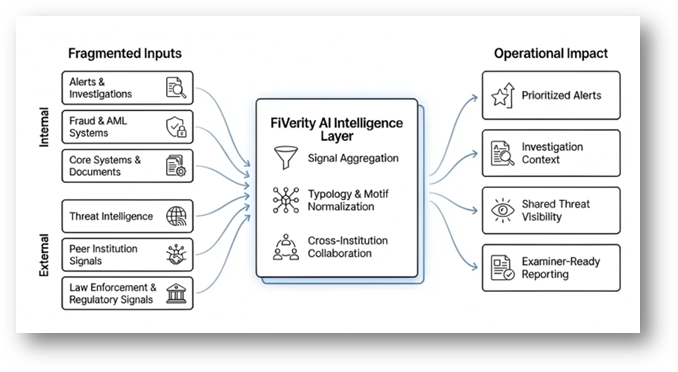
Fraud and AML teams operate in an environment where signals are generated across many different systems — transaction monitoring engines, onboarding risk tools, behavioral models, and fraud detection platforms. Each system is designed to surface suspicious activity, but the signals they generate rarely arrive with enough context for investigators to quickly understand the full picture.
Many attacks now rely on social engineering, convincing customers to reveal credentials or authorize transactions. At the same time, organized fraud networks increasingly reuse tactics across institutions and victims, leaving signals scattered across multiple systems.
Once an alert is generated, investigators still need to understand the broader pattern of activity, prioritize risk, and determine the appropriate response.
Emerging fraud tactics are often engineered to bypass individual rules or models. As a result, investigators still spend valuable time reconstructing the full picture of risk before they can determine the right course of action.
Intelligence That Runs Alongside Your Existing Systems
To address this gap, we are introducing new capabilities that apply an AI-native intelligence layer directly inside fraud and AML workflows.
This intelligence layer runs alongside existing fraud, AML, and core systems without requiring API integrations or system replacement. Institutions can deploy it in a matter of weeks while continuing to operate the tools they already rely on.
Rather than replacing detection systems, FiVerity connects them — aggregating signals, identifying patterns, and giving investigators the context needed to prioritize and respond faster.
In practice, this layer sits between detection systems and investigation workflows, connecting signals and translating them into actionable intelligence for investigators.
What’s New in This Release
These new capabilities operationalize unified intelligence inside alert triage, investigations, and documentation workflows.
Pattern Recognition Through Typologies and Motifs
Fraud signals are mapped to typologies and motifs — an intelligence framework that links signals to known fraud patterns and behavioral indicators.
Motifs represent individual behavioral signals, while typologies represent the broader fraud patterns those signals form. Together they help investigators quickly understand what type of activity they may be dealing with.
Shared account information, device IDs, IP addresses, behavioral signals, application patterns, and transaction characteristics are evaluated together to identify coordinated fraud activity.
Because fraudsters often reuse infrastructure, devices, and tactics across multiple victims and institutions, recognizing these patterns early can significantly accelerate investigations.
This intelligence map helps investigators understand the broader pattern behind an alert, not just the alert itself.
Unified Alert Ingestion
Alerts from fraud, AML, onboarding, and transaction monitoring systems are aggregated into a single investigative view.
This allows investigators to evaluate signals across systems without manually assembling context.
Intelligent Alert Triage
Signals are mapped to typologies and motifs, allowing related alerts to be grouped automatically.
This grouping helps identify:
- Alerts likely representing false positives
- Alerts that require delayed or monitored action
- Alerts that require immediate investigation
Teams can automatically clear or defer low-risk alert groups using configurable rules and intelligence signals, leaving investigators with a prioritized alert queue focused on higher-risk activity.
For example, multiple alerts tied to the same device, account behavior, and transaction pattern may indicate an account takeover pattern. Grouping these signals allows investigators to evaluate the full pattern of activity rather than reviewing alerts individually.
Guided Investigations
Once a typology or pattern is identified, investigators are guided through next-best-action workflows that structure how signals are evaluated, documented, and resolved.
These workflows help investigators determine what evidence to review, what signals to verify, and what investigative steps should occur next.
This reduces the time investigators spend determining what to do next while improving investigation consistency across teams.
For instance, when signals suggest a potential account takeover pattern, investigators may be guided to review recent credential changes, device activity, and linked account behavior before determining whether escalation is required.
Documentation and Reporting Support
Investigation findings are structured into consistent, examiner-ready documentation, capturing signals, evidence, and investigator decisions in a transparent audit trail.
This supports fraud case review, internal oversight, and regulatory reporting expectations.
Why This Matters
Fraudsters reuse infrastructure, tactics, and behavioral signals across victims and institutions. When investigators see alerts individually rather than as connected signals, those patterns are difficult to recognize early.
By connecting signals across systems and institutions, the intelligence layer helps investigators identify those patterns sooner.
Operationally, this helps institutions:
- Prioritize alerts more accurately
- Reduce time spent clearing false positives
- Shorten investigation cycles
- Produce stronger, more consistent documentation
Just as importantly, these gains are achieved without replacing existing systems.
The intelligence layer enhances the tools institutions already use by providing the cross-system context those systems cannot see independently.
See It in Action
On March 25 at 1:00 PM ET, we will walk through these new capabilities live.
You’ll see how alerts are ingested across systems, how typologies and motifs provide context, how alerts are grouped into prioritized investigation queues, and how next-best-action workflows guide investigators through resolution and documentation.
You can register here to reserve your spot.